Overview
High-fidelity Graphical User Interface (GUI) prototyping is a well-established and suitable method for enabling fruitful discussions, clarification and refinement of requirements formulated by customers. GUI prototypes can help to reduce misunderstandings between customers and developers, which may occur due to the ambiguity comprised in informal Natural Language (NL). However, a disadvantage of employing high-fidelity GUI prototypes is their time-consuming and expensive development. Common GUI prototyping tools are based on combining individual GUI components or manually crafted templates. In this work, we present GUI2WiRe, a tool that enables users to retrieve GUI prototypes from a semi-automatically created large-scale GUI repository for mobile applications matching user requirements specified in Natural Language (NLR). We extract multiple text segments from the GUI hierarchy data and employ various Information Retrieval (IR) models and Automatic Query Expansion (AQE) techniques to achieve ad-hoc GUI retrieval from NLR. Retrieved GUI prototypes mined from applications can be inserted in the graphical editor of GUI2WiRe to rapidly create wireframes. GUI components are extracted automatically from the GUI screenshots and basic editing functionality is provided to the user. Finally, a preview of the application is created from the wireframe to allow interactive exploration of the current design. We evaluated the applied IR and AQE approaches for their effectiveness in terms of GUI retrieval relevance on a manually annotated collection of NLR and discuss our planned user studies.
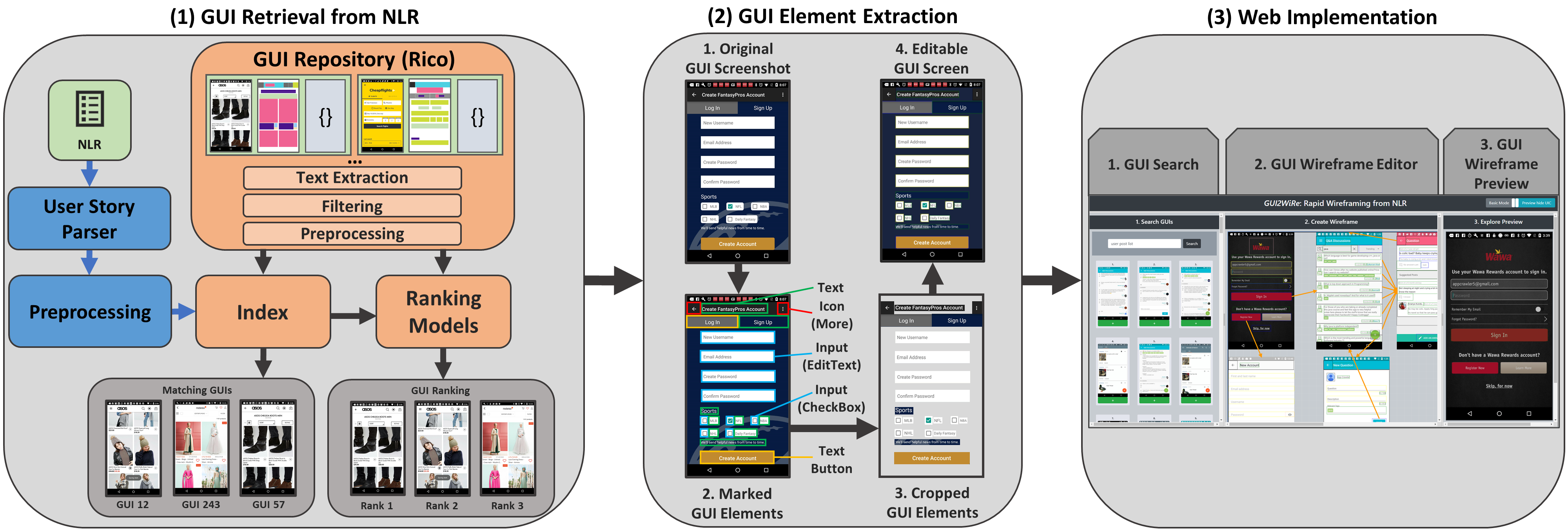
The figure shows an overview of the three main parts of GUI2WiRe. First, (1) a GUI retrieval component that parses and preprocesses user input in the form of simple keyword-based search queries or user stories and computes a ranking over the large-scale semi-automatically created GUI dataset Rico that contains over 72,000 unique GUIs from Android applications. Second, (2) a GUI element extraction component that employs the mined GUI hierarchy data to automatically mark and crop the GUI elements from the mined GUI screenshots allowing to edit and use them for wireframing. In the current version of GUI2WiRe, editing functionality is restricted to removing, copying and binding UI components to other screens allowing users to create custom GUIs with UI components extracted from different applications. Third, (3) a web-based GUI wireframing editor that enables users to rapidly edit the retrieved GUI prototypes, create screen transitions and explore a basic and interactive application preview. The current version of GUI2WiRe can be tested here. The full repository can be found at RaWi Repository.
Watch Tool Demonstration on Youtube
References
Kristian Kolthoff, Christian Bartelt, and Simone Paolo Ponzetto. 2020. GUI2WiRe: Rapid Wireframing with a Mined and Large-Scale GUI Repository using Natural Language Requirements. In 35th IEEE/ACM International Conference on Automated Software Engineering (ASE ’20), September 21–25, 2020, Virtual Event, Australia. ACM, New York, NY, USA, 5 pages. https://doi.org/10.1145/3324884.3415289
Find us at the Institute for Enterprise Systems (InES), University of Mannheim